http://www.slideshare.net/rahuldausa/real-time-analytics-with-apache-kafka-and-apache-spark
https://github.com/miguno/kafka-storm-starter
Monday, April 25, 2016

Saturday, April 23, 2016
Friday, April 22, 2016
CACHE - distributed cache
http://www.codeproject.com/Articles/21508/Distributed-Caching-Using-a-Hash-Algorithm

In computing, a distributed cache is an extension of the traditional concept of cache used in a single locale. A distributed cache may span multiple servers so that it can grow in size and in transactional capacity. It is mainly used to store application data residing in database and web session data.
Hashing algorithm that can be used in distributed caching of data in web farms or implementing a distributed hash table (DHT).
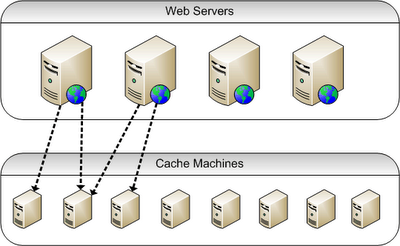
We have a layer of web servers that handle the requests and a pool of machines that are used for caching. Each web server should be able to access any of the cache machines. The tricky aspect here is that when we cache some data as a result of a request to a particular web server, we should be able to retrieve that data from any of the other web servers.
Here is what we can do. We want to cache key value pairs and then at a later stage get hold of a cached value by providing the corresponding key. The code below takes a key and produces a hash bit array using SHA1. Then after some transformations we derive an integer number. A given key always produces the same number. In addition, all numbers are uniformly distributed which allows us to "page" them and assign them to a given number of cache machines or "buckets".
In computing, a distributed cache is an extension of the traditional concept of cache used in a single locale. A distributed cache may span multiple servers so that it can grow in size and in transactional capacity. It is mainly used to store application data residing in database and web session data.
Hashing algorithm that can be used in distributed caching of data in web farms or implementing a distributed hash table (DHT).
We have a layer of web servers that handle the requests and a pool of machines that are used for caching. Each web server should be able to access any of the cache machines. The tricky aspect here is that when we cache some data as a result of a request to a particular web server, we should be able to retrieve that data from any of the other web servers.
Here is what we can do. We want to cache key value pairs and then at a later stage get hold of a cached value by providing the corresponding key. The code below takes a key and produces a hash bit array using SHA1. Then after some transformations we derive an integer number. A given key always produces the same number. In addition, all numbers are uniformly distributed which allows us to "page" them and assign them to a given number of cache machines or "buckets".
Thursday, April 21, 2016
ALGORYTHMS - animated and video examples
http://www.sorting-algorithms.com/
https://www.youtube.com/embed/vxENKlcs2Tw
https://www.youtube.com/embed/vxENKlcs2Tw
Tuesday, April 19, 2016
Wednesday, April 13, 2016
JAVASCRIPT - visualization of Bitcoins transactions by JS frameworks
Post in Twitter about the matter: https://twitter.com/pluralsight/status/719978158963978240
Example of JS visualization of Bitcoin transactions: http://bitbonkers.com/
JS framework Three JS: http://threejs.org/
JS framework Oimo JS: http://lo-th.github.io/Oimo.js/
Live stream of Bitcoins transactions: https://blockchain.info/
Example of JS visualization of Bitcoin transactions: http://bitbonkers.com/
JS framework Three JS: http://threejs.org/
JS framework Oimo JS: http://lo-th.github.io/Oimo.js/
Live stream of Bitcoins transactions: https://blockchain.info/
Tuesday, April 12, 2016

Monday, April 11, 2016
TCP - 3 Way handshake SYN, SYN-ACK, ACK
http://www.inetdaemon.com/tutorials/internet/tcp/3-way_handshake.shtml

| EVENT | DIAGRAM |
Host A sends a TCP SYNchronize packet to Host B
Host B receives A's SYN
Host B sends a SYNchronize-ACKnowledgement
Host A receives B's SYN-ACK
Host A sends ACKnowledge
Host B receives ACK.
TCP socket connection is ESTABLISHED.
|  TCP Three Way Handshake (SYN,SYN-ACK,ACK) |
Subscribe to:
Posts (Atom)